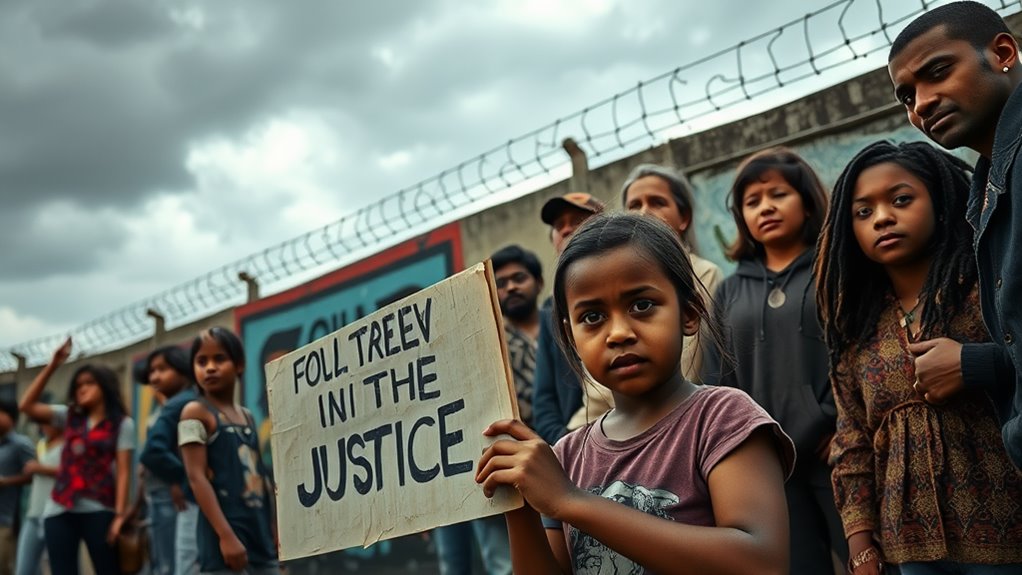
The world currently faces significant human rights issues, including systemic discrimination and economic inequality, particularly evident in education, healthcare, and employment. Millions are affected by the refugee crisis, with inadequate access to services and legal recognition. In many regions, suppression of free speech and a rise in authoritarianism threaten democratic values. Furthermore, climate change disproportionately impacts marginalized communities, linking environmental injustice to human rights. These interconnected challenges demand urgent attention and deeper examination.
Systemic Discrimination and Inequality
Systemic discrimination and inequality represent significant barriers to the realization of human rights globally. Systemic racism and economic inequality intertwine to create pervasive disparities that affect marginalized communities. This form of discrimination manifests in various sectors, including education, healthcare, and employment, limiting access to opportunities and resources. For instance, individuals from racially marginalized groups often face biases in hiring practices, resulting in lower wages and job security.
Moreover, economic inequality exacerbates these challenges, as wealth is concentrated among a privileged few, leaving disenfranchised populations struggling for basic needs. The impact is profound; it perpetuates cycles of poverty, health disparities, and social exclusion. Addressing systemic discrimination requires thorough policy reform and societal commitment to equity, ensuring that all individuals can enjoy their fundamental rights. Without such efforts, the cycle of inequality continues, undermining the principles of justice and dignity that underpin human rights for all.
The Refugee Crisis and Displacement
The plight of refugees and internally displaced persons is a pressing human rights issue that often arises from systemic discrimination and inequality. Millions are uprooted by conflict, persecution, and environmental disasters, seeking safety and stability. These individuals face numerous challenges, including inadequate access to basic services, legal recognition, and economic opportunities.
Refugee rights, grounded in international law, emphasize the necessity of protection and support for those fleeing dire circumstances. Nonetheless, many countries implement displacement policies that prioritize national security over humanitarian needs, further complicating the situation.
The lack of effective solutions leads to prolonged suffering for displaced populations, highlighting the urgent need for thorough strategies that address the root causes of displacement and uphold the rights of refugees. Global cooperation and commitment to equitable policies are vital for encouraging durable solutions and ensuring that the dignity of all displaced individuals is respected and upheld.
Suppression of Free Speech and Censorship
Although free speech is a fundamental human right, its suppression and censorship remain prevalent issues worldwide. Many governments employ various tactics to limit open expression, often justifying their actions as necessary for national security or societal harmony. Social media censorship has emerged as a significant concern, with platforms increasingly pressured to regulate content deemed inappropriate or dangerous. This creates an environment where dissenting voices may be silenced, leading to a homogenization of viewpoints.
Moreover, government propaganda plays a pivotal role in shaping public perception, often distorting facts to maintain control over narratives. The manipulation of information not only stifles free discourse but also undermines democratic principles. Citizens, fearful of repercussions, may self-censor, further eroding the space for healthy debate. Addressing these issues is vital for encouraging a society that values diverse opinions and upholds the vital principle of free expression.
The Rise of Authoritarianism
How has the rise of authoritarianism reshaped global governance? In recent years, many nations have witnessed a resurgence of authoritarian regimes, characterized by political repression and a significant curtailing of civil liberties. These governments often prioritize state control and stability over individual rights, leading to the suppression of dissent and the erosion of democratic institutions. As leaders consolidate authority, they employ tactics such as censorship and surveillance, undermining the freedoms of expression and assembly. The global environment has become increasingly polarized, with some countries embracing authoritarian practices as others struggle to uphold democratic values. This shift poses challenges for international relations, as authoritarian states often reject global norms related to human rights. The rise of authoritarianism not only threatens individual freedoms but likewise undermines collective efforts to promote democracy and justice worldwide, making it a pressing human rights issue that demands urgent attention. In this context, navigating international law challenges becomes essential as the international community grapples with how to respond to these authoritarian regimes. Many governments are faced with the dilemma of balancing diplomatic relations with the need to hold such states accountable for their human rights violations. As multilateral institutions struggle to maintain their relevance, the effectiveness of global governance mechanisms is increasingly tested, necessitating a reevaluation of strategies to promote democracy and uphold the rule of law in an era fraught with authoritarian resurgence.
Climate Change and Environmental Justice
Amidst the backdrop of rising authoritarianism, climate change emerges as a pressing human rights issue that exacerbates existing inequalities. The impacts of climate change disproportionately affect marginalized communities, highlighting the urgent need for climate justice. Vulnerable populations often bear the brunt of environmental degradation, facing displacement, health risks, and loss of livelihoods. This scenario is intensified by environmental racism, where low-income and minority communities are more likely to be located near hazardous waste sites and suffer from polluted air and water.
As climate-related disasters become more frequent, the intersection of human rights and environmental sustainability becomes increasingly evident. Advocates argue that addressing climate change requires not just environmental policies but also a commitment to social equity. Ensuring that all voices are heard in climate discussions is vital for achieving a fair and just response to this global crisis. In the end, climate justice is integral to protecting human rights in an era of significant environmental upheaval.
Frequently Asked Questions
What Are the Primary Causes of Systemic Discrimination Globally?
Systemic discrimination, a complex and multifaceted beast, often thrives on historical injustices like weeds in a garden. At its core, intersectional discrimination plays a vital role, where individuals face overlapping biases based on race, gender, and socioeconomic status. This intricate web of prejudice is woven through societal structures, perpetuating inequality and nurturing environments where discrimination festers. Comprehending these underlying causes is fundamental for dismantling the barriers that hinder progress toward a more equitable world.
How Can Individuals Support Refugees in Their Communities?
Individuals can support refugees in their communities by participating in local initiatives that promote community integration. This involvement may include volunteering with organizations that provide resources and services to newcomers, offering language classes, or hosting cultural events that encourage comprehension. Moreover, they can advocate for policies that support refugee rights and access to crucial services. By actively engaging in these actions, individuals contribute to building a more inclusive and supportive environment for refugees.
What Impact Does Censorship Have on Society's Development?
Censorship acts as a dark cloud, obscuring the sun of freedom of expression. This stifling atmosphere leads to detrimental censorship consequences, hindering societal development. The absence of diverse voices prevents innovation and critical thinking, creating a stagnant culture. As ideas are silenced, the potential for growth diminishes, leaving communities vulnerable to ignorance. Ultimately, the suppression of thought restricts both individual rights and the collective progress vital for a thriving society.
How Can Citizens Resist Authoritarian Regimes Effectively?
Citizens can effectively resist authoritarian regimes through strategies such as peaceful protests and digital activism. Peaceful protests serve to unify individuals and draw attention to their cause, nurturing a sense of solidarity. Meanwhile, digital activism allows for the rapid dissemination of information and mobilization of supporters across vast networks, making it difficult for authorities to suppress dissent. Together, these methods create a resilient framework for challenging oppressive systems and advocating for democratic freedoms.
What Role Does Education Play in Promoting Human Rights Awareness?
Research indicates that individuals who receive human rights education are 60% more likely to engage in activism. Education plays an essential role in promoting human rights awareness through curriculum development that incorporates thorough human rights topics. Awareness campaigns further amplify this impact by reaching broader audiences, nurturing comprehension and empathy. Together, these efforts create informed citizens who advocate for justice and equality, in the end helping to shape a more equitable society.